
Well Water in Carson Valley
Thousands of homes in Carson Valley, from Johnson Lane to the Gardnerville Ranchos, run on private wells, and a 2024 U.S. Geological Survey study found arsenic and nitrate worth testing for in several areas. Water Pros offers free local basic testing for hardness, iron and pH, and we help well owners choose lab tests and treatment.
Key points
- USGS counted 1,074 domestic wells in Johnson Lane, 653 in East Valley and 530 in Ruhenstroth, among other areas.
- Arsenic was over 5 micrograms per liter in most samples from several areas, and often over the federal limit of 10.
- Selected Johnson Lane and Ranchos wells had nitrate above the limit, with rising trends.
- Testing, then treating what the results show, is the practical path.
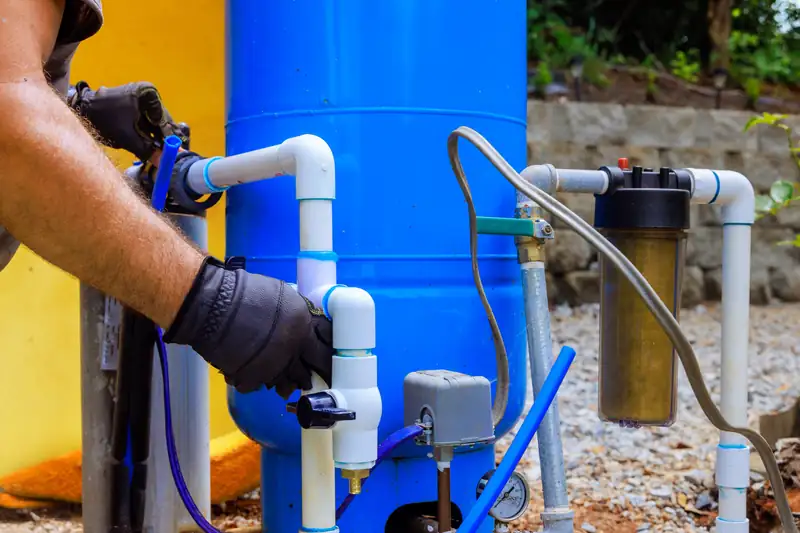
Carson Valley's wells draw from an aquifer that has been studied closely. The USGS's 2024 report gives well owners unusually specific information about their own neighborhoods, and it points to a few things every owner should check.
How many private wells are in Carson Valley?
The U.S. Geological Survey's Open-File Report 2024-1045 describes the Carson Valley groundwater system and counts domestic wells by area. The numbers below are from that report.
That is a lot of households responsible for their own water. Douglas County has no county well-testing program that we found, and the state's Bureau of Safe Drinking Water does not regulate private well water quality, so an owner's own lab test is the check.
| Area | Domestic wells (USGS 2024) |
|---|---|
| Johnson Lane | 1,074 |
| East Valley | 653 |
| Ruhenstroth | 530 |
| Foothill | 416 |
| Indian Hills / Jacks Valley | 406 |
| Fish Springs | 328 |
| Gardnerville Ranchos | 317 |
| Genoa | 239 |
What did USGS find about arsenic in Carson Valley wells?
Arsenic is the headline. The report found arsenic above 5 micrograms per liter in most samples from the Johnson Lane, Airport, Central Ag and East Valley areas, and often above 10, which is the EPA's maximum contaminant level. Deeper-screened wells were more vulnerable in the study. The USGS Nevada Water Science Center also notes that Douglas County removed northern Carson Valley production wells because of high arsenic.
Arsenic has no taste, smell or color, so the only way to know a well's level is a certified lab test. Our arsenic in Nevada well water guide explains the standard and the treatment options, and our reverse osmosis and arsenic guide covers the kitchen tap approach.
Why is water level and well depth part of the story?
The USGS report documents that many wells here have been deepened. Of 239 deepened wells in its inventory, 171 were in Johnson Lane, Ruhenstroth, East Valley and Indian Hills, and water-level declines of more than 20 feet showed up in several areas. A deeper well can reach different water, so a test that was fine five years ago is not a guarantee today.
If your well has been deepened, has had pump work, or has a new owner, retest. We recommend a full analysis every 3 to 5 years, and UNR Extension adds yearly checks for nitrate, pH, TDS and coliform bacteria.
What about nitrate, radon and town water?
The USGS report found nitrate above the 10 milligrams per liter limit in selected Johnson Lane and Gardnerville Ranchos wells, with increasing trends. Nitrate is a good reason for a yearly test, and for owners with infants or anyone pregnant it deserves a certified lab result. Our nitrate guide covers the details.
For comparison, the Town of Minden's report on 2025 water listed radon at 557.6 pCi/L (sampled in 2015) and arsenic up to 11 ppb, with compliance judged on an average, as the rules provide. Radon in water has no federal limit. Private wells in the valley can differ from municipal wells, which is one more reason each well deserves its own test. Visit our Minden and Gardnerville page for the town water picture.
What should a Carson Valley well owner do?
Take a few steps in order, and stop when you have the answer you need:
- Start with our free local basic test for hardness, iron and pH, to see the everyday side of your water.
- Order a Routine Domestic Panel from a Nevada-certified lab, and ask about arsenic, uranium, nitrate and radioactivity.
- Compare the results with the EPA limits: 10 micrograms per liter arsenic, 10 milligrams per liter nitrate as nitrogen and 30 micrograms per liter uranium.
- Choose treatment for what the report shows, and retest after installation to confirm it works.
- Set up maintenance so filters and media are handled on a schedule.
How Water Pros helps in Carson Valley
We test, then treat. That can mean a water softener for hardness, an arsenic filter, a nitrate system, radon gas filtration or a reverse osmosis drinking water system. See well water treatment for how they combine.
We service most water treatment equipment, even if it was not installed by us, with a flat-rate service call fee, no hourly labor charges and no fuel surcharges. Call 775-674-2871 or visit the scheduling page.
Sources (5)
- U.S. Geological Survey: USGS OFR 2024-1045 (Naranjo & Bubiy), water levels, nitrate and arsenic, Carson Valley (checked November 2026)
- Town of Minden: Town of Minden CCR covering calendar 2025 (checked November 2026)
- U.S. Geological Survey: usgs.gov/centers/nevada-water-science-center/science/arsenic-nevada-groundwater (checked November 2026)
- U.S. EPA: epa.gov/ground-water-and-drinking-water/national-primary-drinking-water-regulations (checked November 2026)
- Nevada Division of Environmental Protection: ndep.nv.gov/uploads/water-labcert-dwtesting-docs/WellWaterTesting.pdf (checked November 2026)