

Nitrate in Nevada Well Water
The federal drinking water limit for nitrate is 10 milligrams per liter as nitrogen, and it has no taste, color or smell, so a yearly test is the way to track it on a private well. If a result runs high we install nitrate filtration or reverse osmosis to bring it down.
Key points
- EPA limit: 10 mg/L as nitrogen.
- UNR Extension advises testing every year for nitrate.
- USGS has documented rising nitrate in several Northern Nevada areas where wells and septic systems share an aquifer.
- Nitrate responds to ion exchange filtration and reverse osmosis, chosen from your test results.
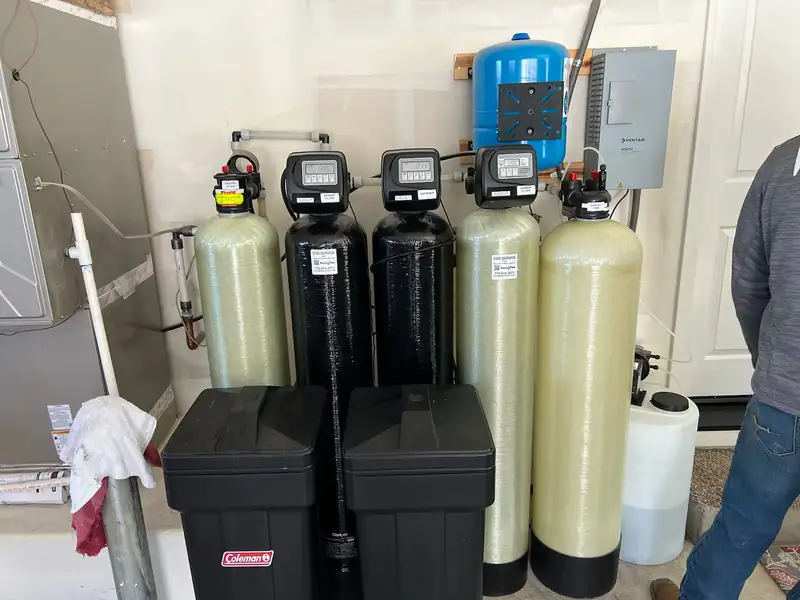
Nitrate is the test most worth repeating. Unlike arsenic or uranium, which come from rock and change slowly, nitrate depends on what happens on the land above the aquifer, so it can rise or fall from year to year.
Where does nitrate in well water come from?
Nitrate forms when nitrogen from septic systems, fertilizer, animal waste or decaying plants is converted by soil bacteria and carried down to groundwater. In places where homes on septic systems sit above the same aquifer their wells draw from, the nitrogen load adds up over time.
The EPA limit is 10 milligrams per liter measured as nitrogen. UNR Extension lists a pregnancy or an infant under 6 months in the home among the reasons to test, so a household with a new baby should check this number first.
What has USGS found in Northern Nevada?
The U.S. Geological Survey has tracked nitrate in several local basins. A 2006 report found rising nitrate in Spanish Springs municipal wells, in an area with more than 2,000 septic systems. A 1996 report found nitrate over the standards in several wells in the Lemmon Valley and Golden Valley area. A 2024 report on Carson Valley found selected Johnson Lane and Gardnerville Ranchos wells over the limit, with rising trends.
These are studies of specific wells and basins, not a statement about every home. What they show is that nitrate deserves its own yearly line in your testing calendar.
| Area | Publisher and year | Finding |
|---|---|---|
| Spanish Springs | USGS 2006 | Rising nitrate in municipal wells; 2,000+ septic systems |
| Lemmon and Golden Valley | USGS 1996 | Nitrate over standards in several wells |
| Johnson Lane and Ranchos, Carson Valley | USGS 2024 | Selected wells over the limit, with rising trends |
| Winnemucca | City report, 2025 | Nitrate printed at 9.8 mg/L against the limit of 10 |
The Winnemucca figure is a public system reporting on its own water and meeting the standard. We include it because it shows how close to 10 a real result can land, and why people watch the trend.
How often should you test for nitrate?
UNR Extension's guidance for private well owners is to test every year for nitrate, pH, total dissolved solids and total coliform bacteria, and a broad panel every 5 to 10 years. Because nitrate can move from year to year, a single clean result does not close the question. Test right away after flooding, after well or pump maintenance, or if the neighborhood adds septic systems.
Our well testing guide shows the lab panel to order, and the guide to reading a water test report explains why nitrate is printed "as N."
Keep every nitrate result in one place. Two or three years of numbers show whether your well is steady or climbing, and that trend is what decides whether a tap-level system is enough or a whole-house system makes sense.
How do you remove nitrate?
Nitrate needs its own approach: boiling does not lower it, and a standard softener or carbon filter is built for other jobs. Our nitrate filtration systems use an ion exchange resin that is recharged on a schedule, and reverse osmosis at the kitchen tap treats the water used for drinking and cooking.
Which one fits depends on the result and on how much of the house you want treated. A reading just under the limit may call for a tap-level system plus a regular retest; a higher reading may call for a whole-house system. We explain both before anything is installed.
What Water Pros does about nitrate
Begin with a lab panel, since a certified lab is how you know your number. We can help you read the report and walk through the options. You don't have to be an existing customer.
If treatment makes sense, we install the system, recommend a test of the treated water, and set up a maintenance plan so the resin or membrane is serviced on schedule. We also service nitrate and other well filtration equipment even if it was not installed by us. See our water testing and well water treatment pages for how it works.
Sources (6)
- U.S. EPA: epa.gov/ground-water-and-drinking-water/national-primary-drinking-water-regulations (checked November 2026)
- U.S. Geological Survey: USGS SIR 2006-5206, septic nitrogen in Spanish Springs Valley (checked November 2026)
- U.S. Geological Survey: USGS OFR 96-461 (Seiler), nitrate in Lemmon and Golden Valleys (checked November 2026)
- U.S. Geological Survey: USGS OFR 2024-1045 (Naranjo & Bubiy), water levels, nitrate and arsenic, Carson Valley (checked November 2026)
- cdn.myocv.com: City of Winnemucca 2025 CCR (checked November 2026)
- Nevada Division of Environmental Protection: ndep.nv.gov/uploads/water-labcert-dwtesting-docs/WellWaterTesting.pdf (checked November 2026)