

How Often to Add Salt to a Water Softener
Look in the brine tank about once a month and add salt well before it runs low, keeping it above the water line and following your softener manufacturer's directions. How quickly you go through salt depends mostly on your water's hardness and how much water your household uses.
Key points
- A monthly look into the brine tank is a good habit for most households.
- Keep the salt above the water line so the softener can make strong brine.
- Harder water and more water use mean faster salt use.
- We check the brine tank draw and refill and sanitize the salt tank at each maintenance visit.
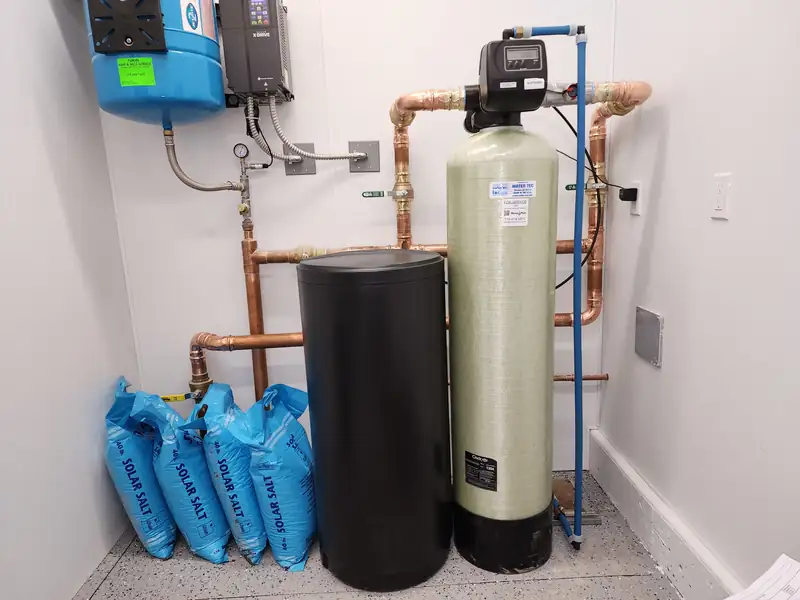
How to check the salt level
Lift the lid of the brine tank, the tall plastic tank next to your softener, and look at how much salt is inside. Add more well before it runs low, and follow the fill guidance in your softener's manual. Never let the pile sink below the water line, because brine is made when water meets salt, and a tank without enough salt makes weak brine.
Make the check part of a monthly routine, such as the first of the month. A quick look takes a minute, and it avoids the surprise of hard water returning because the tank ran dry.
If you rent or have just moved in, finding the brine tank is the first step. It is usually a tank with a lid sitting beside the larger resin tank, and the salt sits inside it.
What decides how fast you use salt
Salt use follows the work the softener has to do. Every grain of hardness removed from every gallon uses up a bit of the resin's capacity, and the salt reloads it. The USGS hardness scale gives the yardstick: water over 180 mg/L is very hard, so a home on very hard water asks more of its softener than one on moderately hard water.
A few factors change the pace:
Seeing your own numbers over a few months is more useful than any average, because it shows what normal looks like for your house.
- Your water's hardness. Dayton's published range of 197 to 506 mg/L calls for far more regeneration than Minden's 94 to 140 mg/L.
- Household size. More people means more gallons softened each day.
- Iron in the water. Iron adds to the load on the resin, so it uses salt faster.
- Softener settings. The regeneration schedule and salt dose are set on the control head.
- Season. TMWA's neighborhood hardness changes from quarter to quarter, so salt use can too.
A simple guide to checking and refilling
Use this routine each month:
- Lift the lid and look at the salt level and the surface of the salt.
- If the level is getting low, add salt of the type your system uses.
- If the top of the salt has hardened into a crust, break it up gently; a crust can hide an empty gap underneath.
- Keep the salt above the water line, and note the date so you can see your own pattern.
- If you add salt more or less often than before, let us know, because a change in pattern can mean a change in the water or in the settings.
When the salt keeps disappearing, or never moves
If the tank empties much faster than it used to, read our guide on a softener using too much salt. If the level barely changes for months, the softener may not be drawing brine, so the water is likely going hard even though the tank looks full. A hardness test at the tap settles it in a minute.
A realistic schedule for different homes
There is no single right interval. A small household on moderately hard water refills less often than a large household on very hard water. What matters is that you learn your own pattern and notice when it changes.
If you travel for part of the year, check the tank before you leave and when you return. A softener that sat unused for months can have a hard crust in the tank, and a quick look puts you on top of it.
What Water Pros does about it
Our maintenance visits include a brine tank draw and refill check, which means we confirm the softener pulls brine and refills as it should, along with salt tank sanitation each visit and a check of regeneration cycles and settings. Our system maintenance page lists the full visit, and we build a plan around your system.
Start with free local basic testing to include hardness, iron and pH; those numbers tell us how much work your softener faces. You do not have to be an existing customer, and our water softener service covers most systems, even if they were not installed by us.
Sources (7)
- waterprosnv.com: Water Pros: System Maintenance (checked November 2026)
- U.S. Geological Survey: usgs.gov/special-topics/water-science-school/science/hardness-water (checked November 2026)
- Truckee Meadows Water Authority: TMWA neighborhood water quality lookup, sampling Q4 2025 - Q3 2026 (checked November 2026)
- Lyon County: Lyon County Utilities, Dayton Valley water system 2023 CCR (latest posted) (checked November 2026)
- Town of Minden: Town of Minden CCR covering calendar 2025 (checked November 2026)
- health.state.mn.us: health.state.mn.us/communities/environment/water/factsheet/softening.html (checked November 2026)
- Penn State Extension: extension.psu.edu/water-softening (checked November 2026)