

Why Is My Reverse Osmosis Slow?
A slow reverse osmosis faucet most often traces to worn pre-filters, low pressure in the holding tank, or a membrane that has reached the end of its life. We replace the filters, check the tank pressure, test TDS to verify the membrane and recharge the tank, and we service RO systems even if they were not installed by us.
Key points
- Check the easy things first: filters, the shutoff valve and the tank.
- We recommend changing RO filters every 6 months, and not going past 1 year.
- A TDS test tells you whether the membrane is still doing its job.
- A slow faucet and a bad taste can have different causes, so test before replacing parts.
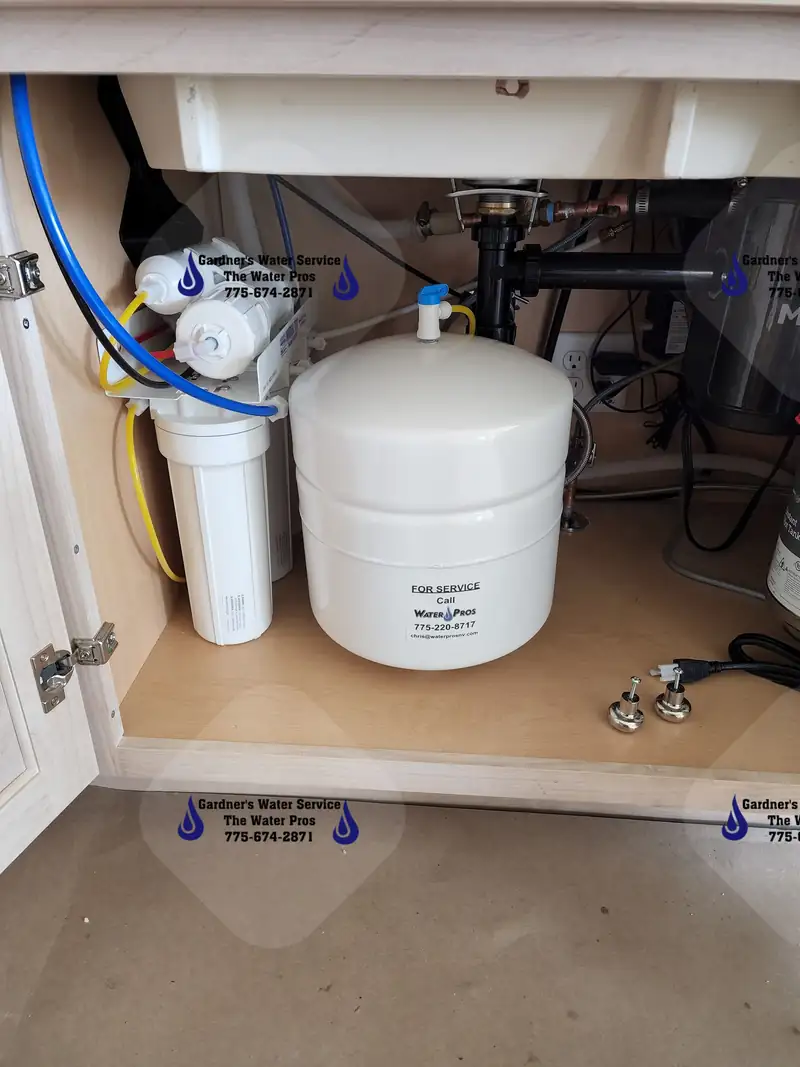
What are the most common reasons an RO system is slow?
An RO system pushes water through a very fine membrane, and anything that restricts the flow ahead of it, or leaves the tank under-pressurized behind it, shows up as a thin stream at the drinking faucet. In rough order of how often we find them:
| Likely cause | What you notice | Fix |
|---|---|---|
| Worn sediment or carbon pre-filters | Slow fill of the tank, weak flow, taste change | Replace pre-filters and sanitize the housings |
| Low holding-tank pressure | Faucet starts strong, then dwindles quickly | Check tank air pressure and recharge the tank |
| Membrane near the end of its life | Slow flow plus rising TDS in the treated water | Test TDS, then replace the membrane |
| Low feed pressure or a partly closed supply valve | Slow fill, long run time | Check the supply valve and the incoming pressure |
| Clogged post-filter or faucet | Good tank, weak flow at the faucet | Replace the post-filter and clean the faucet |
Several of these can happen together, so we go through the list rather than stopping at the first one.
How do filters affect speed?
Pre-filters protect the membrane from sediment and chlorine. As they load up, they restrict the water that reaches the membrane, and the tank fills more slowly. Our own recommendation is to change RO filters every 6 months, and not to go beyond a year. Sediment filters in whole-house housings run on their own schedule, typically 3 to 6 months or when pressure drops.
Filter replacement matters for more than speed. Bacteria can form and breed in and on filters, which is why we clean and sanitize the housings and lubricate the seals and gaskets whenever we replace them. Our filter replacement page describes that visit.
What does the holding tank have to do with it?
The tank stores treated water under air pressure, and that pressure is what pushes water out of the faucet. If the air side loses pressure, the tank may seem full but deliver only a trickle, or run out after a glass or two. Checking tank pressure and recharging it as needed is part of our standard RO visit.
Your own habits matter too. A small tank that is drawn down quickly for cooking or filling a large bottle has to refill before it delivers again, and a refill from empty takes time even in a healthy system. If the system keeps up with a single glass but not with heavy use, the tank is working as designed and the question becomes whether it is sized for your household.
How do I know if the membrane is the problem?
The membrane is the part that does the separating, and its health shows up in the numbers more than in the flow. We test total dissolved solids (TDS) in the treated water to verify membrane performance. When the TDS reading climbs toward what comes out of the tap, the membrane is no longer rejecting dissolved solids the way it should.
This matters for health items too. The U.S. Geological Survey studied household RO systems on private wells in the Lahontan Valley and found that treated water was not always below the arsenic limit; drops in conductivity did not always line up with drops in arsenic, so the authors recommended testing the treated water directly. Our guide on whether reverse osmosis removes arsenic has the details. For well owners, a lab test of the treated water is the way to confirm.
What does a Water Pros RO visit include?
Our reverse osmosis service follows a set routine. We replace the pre- and post-filters, sanitize the system housing and the faucet, test TDS to verify membrane performance, check system pressure and recharge the holding tank as needed. The same routine is available on a schedule through our system maintenance plans.
The visit is a flat-rate service call fee with no hourly labor charges and no fuel surcharges. We work on RO systems even if they were not installed by us, and you do not have to be an existing customer. If your water supply itself is the issue, we begin with free local basic testing for hardness, iron and pH, since high hardness or iron upstream can load filters and membranes faster. See our reverse osmosis systems page for how a system is set up, or call 775-674-2871.
Sources (3)
- waterprosnv.com: Water Pros: System Maintenance (checked November 2026)
- waterprosnv.com: Water Pros: System Maintenance FAQ (checked November 2026)
- U.S. Geological Survey: usgs.gov/publications/effectiveness-household-reverse-osmosis-systems-a-western-us-region- (checked November 2026)