

Point-of-Use vs. Whole-House Treatment
Point-of-use treatment cleans the water at one tap, usually the kitchen sink, while whole-house (point-of-entry) treatment cleans it where it enters the home. The right choice depends on what the water analysis finds, so we identify the cause first and then match the equipment.
Key points
- Point of use: reverse osmosis or carbon at the sink for drinking and cooking water.
- Point of entry: a system where water enters the home, treating every tap, appliance and shower.
- Hardness, iron and sulfur are whole-house problems; drinking-water concerns can often be handled at the sink.
- Radon is treated at the point of entry, because it escapes from water into household air.
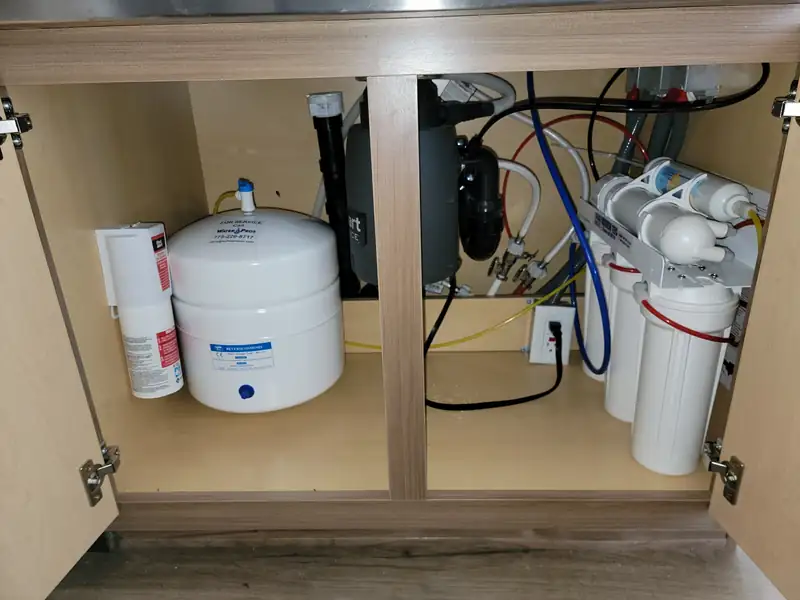
What is the difference between point-of-use and point-of-entry?
Point-of-use (POU) equipment sits at one tap and treats the water drawn there. A reverse osmosis unit under the kitchen sink and a carbon filter at the faucet are the usual examples. Point-of-entry (POE), or whole-house, equipment sits on the main line where water enters the home, so every tap, shower, appliance and water heater receives treated water. Softeners, iron filters and whole-house filtration are POE equipment.
The question we ask first is the one our own FAQ answers: identify what is causing the problem, with a water analysis, before choosing the equipment.
Which problems fit which approach?
Think about where the problem does its damage. If it affects what you drink, a sink-level system can be enough. If it affects pipes, fixtures, laundry or hot water, it needs treating at the entry.
| Concern | Where it shows up | Usual approach |
|---|---|---|
| Hardness and scale | Fixtures, heaters, laundry, dishes | Whole house: softener |
| Iron and manganese | Stains on fixtures and laundry | Whole house: iron filtration |
| Rotten egg smell (hydrogen sulfide) | Every tap, mostly hot water | Whole house: sulfur filtration |
| Sediment | Cloudy water, clogged fixtures | Whole house: sediment filter |
| Chlorine taste | Drinking and cooking water | Sink: carbon filter, or whole-house carbon |
| Arsenic, nitrate, high TDS in drinking water | What you drink and cook with | Sink: reverse osmosis, or whole-house media where needed |
| Radon in well water | Released into the air when water is used | Whole house, at the point of entry |
What about radon and other things that act in the air?
Radon is a gas dissolved in some groundwater. It leaves the water as a gas when you shower, run a tap or do laundry, so a drinking-water filter at the sink does not address the part that reaches the household air. That is why radon in water is treated at the point of entry, before the water is distributed through the house. The EPA publishes national drinking water regulations and guidance for radon, and a few Northern Nevada utility reports print radon results, so check yours. Our radon gas filtration page explains the equipment.
Hydrogen sulfide works similarly: it is a gas you smell at every faucet, so the whole-house approach is the one that matches the problem.
If you rent or are not sure how long you will stay, a sink-level system can move with you, while whole-house equipment becomes part of the plumbing. That is a practical point worth weighing alongside the water analysis.
Can I use both?
Yes, and many homes do. A softener at the entry protects the water heater and fixtures from scale, while a reverse osmosis unit at the kitchen sink polishes the drinking water. Putting hardness treatment ahead of RO also reduces the load on the RO filters and membrane. A well with iron, hardness and arsenic often ends up with a whole-house stage for the first two and a sink-level stage for the drinking water.
Equipment is not the only variable. Households differ in the number of bathrooms, water use and what bothers them most, and a rental or a small cabin may need only a sink unit while a family home with a well needs a full system. Our what treatments are right for me page covers the same questions in FAQ form.
Think about maintenance as well. Whole-house equipment such as a softener needs salt and periodic service, while a sink-level RO unit needs filters changed about every 6 months and no more than a year apart. Either way, the schedule is easier to keep when it is set up as a plan, and we are glad to put one in place through our system maintenance service.
How does Water Pros decide?
We test, then treat. Free local basic testing covers hardness, iron and pH, you do not have to be an existing customer, and well owners should add a lab test, which is typically required for well water. Our water testing page and well water treatment page explain how the results become a plan.
From there we install and service the equipment for homes and businesses, on city water or a well, including systems we did not install. Call 775-674-2871 or use the form below.
Sources (2)
- waterprosnv.com: Water Pros: What Treatments are Right for Me? (checked November 2026)
- U.S. EPA: epa.gov/ground-water-and-drinking-water/national-primary-drinking-water-regulations (checked November 2026)