
Hard Water and Water Heaters
When hard water is heated, calcium carbonate comes out of the water and forms a hard scale on heating elements, burners and the tank bottom. A free hardness test tells you how much scale-forming mineral is in your water, and a softener removes it before the water ever reaches the heater.
Key points
- The U.S. Geological Survey says heating hard water can form calcium carbonate scale that raises heating costs and shortens equipment life.
- Hardness is measured in mg/L or grains per gallon; over 180 mg/L (about 10.5 grains, our conversion) is classed as very hard.
- Scale is easier to prevent than to remove, so the test comes first.
- We service softeners even when we did not install them.
Why does hard water scale up a water heater?
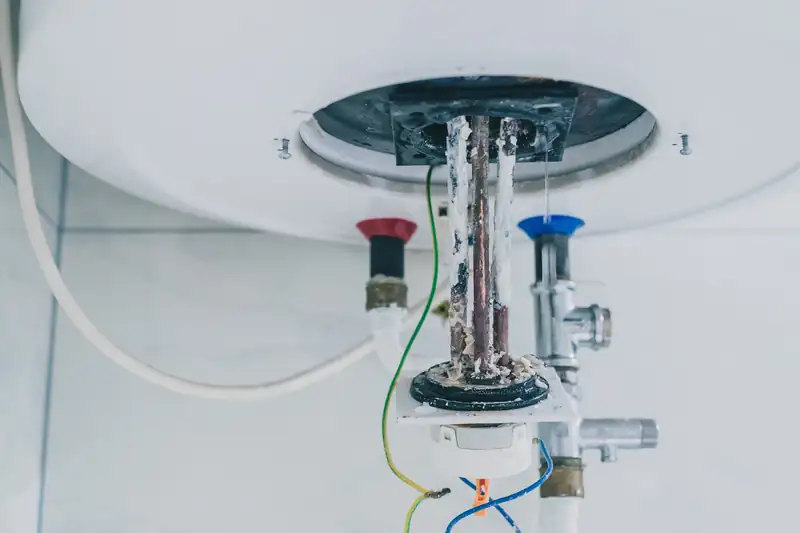
Hard water carries dissolved calcium and magnesium. Heat makes calcium carbonate less soluble, so inside a heater some of it leaves the water and sticks to whatever is hottest. The U.S. Geological Survey Water Science School puts it this way: when hard water is heated, solid deposits of calcium carbonate can form, and that scale can reduce the life of equipment, raise the cost of heating the water, lower the efficiency of electric water heaters and clog pipes.
The deposit is the same chalky white material you see as spots on a glass shower door or a crust on a faucet. In a heater it just happens out of sight, on the heating element of an electric tank, on the bottom of a gas tank, or inside the narrow passages of a tankless unit.
What does the scale do in a tank heater and a tankless heater?
The effect depends on the style of heater, but the cause is identical. Here is where we look for it:
| Heater type | Where scale collects | What you may notice |
|---|---|---|
| Electric tank | On the heating elements and the tank bottom | Longer heat-up times, popping or rumbling noises, elements that wear out sooner |
| Gas tank | As a layer on the bottom, between the flame and the water | Rumbling as water boils under the layer, slower recovery, higher fuel use |
| Tankless | Inside the heat exchanger and small water passages | Reduced flow, temperature swings, error codes that call for descaling |
| Any heater | In the pipes leaving the heater and at fixtures | Weaker flow at hot taps only, white crust on shower heads |
If only the hot side is weak while the cold side runs fine, scale between the heater and the fixtures is a likely reason. Our page on low water pressure after a filter covers the pressure causes that come from the treatment side.
How hard is my water, and does it matter?
The USGS classifies hardness as calcium carbonate in milligrams per liter: 0 to 60 is soft, 61 to 120 moderately hard, 121 to 180 hard and more than 180 very hard. Many water reports print grains per gallon instead. We convert by dividing mg/L by 17.1, so 180 mg/L is about 10.5 grains per gallon.
Northern Nevada ranges widely. Municipal utilities publish hardness in different ways, and private wells vary from one property to the next, even on the same street, so a neighbor's number is not a safe guess for yours. Our water hardness by town page lists every published figure with its source. The Truckee Meadows Water Authority notes that hardness does not affect the safety or quality of tap water; hardness is a question of what your plumbing and appliances have to live with, not of whether the water is safe to drink.
How do you keep a water heater clean when the water is hard?
Two jobs work together: keep scale-forming minerals out of the heater, and look after the heater itself.
Removing hardness before it reaches the heater is the part we handle. A water softener trades the calcium and magnesium for sodium or potassium, so the water entering the heater has nothing to deposit when it heats. Softened water also helps soap lather and leaves fewer spots, which is why most homeowners notice it first at the shower.
- Test the incoming water for hardness, iron and pH before deciding anything.
- If hardness is high, size a softener to the household's water use and the hardness number.
- Keep the softener supplied with salt and serviced on a schedule so it keeps working.
- Follow the heater manufacturer's own instructions for flushing the tank or descaling a tankless unit; scale already in the heater is a heater-side job.
One caution on timing: a softener protects the heater from here on. Scale already built up stays until it is flushed or cleaned out, so some owners flush the tank around the time the softener goes in.
What does Water Pros do about hard water and heaters?
We follow the house line: test, then treat. Free local basic testing includes hardness, iron and pH, and you do not have to be an existing customer. For a well, we also recommend a lab test, which is typically required for well water; see well water testing and water testing. Iron matters here because it can stain and plug in ways a softener alone cannot handle, so we look at all three numbers together.
If a softener is the right answer, we install one for homes and businesses on city water or a well. If you already have one that is not keeping up, we service it, even if it was not installed by us, under a flat-rate service call fee with no hourly labor charges and no fuel surcharges. Our water softener repair and service visit covers the checks that keep the resin and brine side working, and our maintenance plans put those checks on a schedule. Call 775-674-2871 or use the form below.
Sources (2)
- U.S. Geological Survey: usgs.gov/special-topics/water-science-school/science/hardness-water (checked November 2026)
- Truckee Meadows Water Authority: TMWA water quality facts / FAQ (checked November 2026)