
Evaporative Coolers and Hard Water
An evaporative cooler works by evaporating water, and every drop that evaporates leaves its dissolved minerals behind as white scale on pads, trays and fittings. If the water feeding your cooler is hard, we start with a free hardness test and can treat the water at its source so less mineral reaches the cooler.
Key points
- Evaporation leaves calcium and magnesium behind, so scale builds up where the water is used up.
- The Truckee Meadows Water Authority says minerals such as calcium and magnesium deposit a scale as the water evaporates.
- Harder water means faster buildup; a hardness test is the first step.
- Treating the supply removes minerals before they can concentrate in the cooler.
Why do swamp coolers scale up so quickly here?
A swamp cooler cools by pushing air across wet pads. The water that evaporates carries away heat, but the dissolved minerals cannot evaporate with it. They stay in the pan and on the pads, and the longer the cooler runs, the more concentrated the leftover water becomes.
The Truckee Meadows Water Authority describes the same effect in its water quality facts: minerals such as calcium and magnesium, which make up hardness, will deposit a scale as the water evaporates. The U.S. Geological Survey Water Science School describes calcium and magnesium as the two main minerals behind hard water. In a dry climate with long cooling seasons, a cooler can evaporate a great deal of water between its first start and its last run of the year.
What does the buildup look like?
Scale is easy to recognize once you know it. These are the places owners tell us about:
- A white or tan crust on the pads, often stiff and brittle when dry
- A chalky layer in the water pan and on the float valve
- White streaks on the cabinet or on nearby surfaces where water has dripped and dried
- Pump and distribution tubes that clog or run weak
- A musty or mineral smell when the unit starts after sitting
The same chalky material shows up elsewhere in the house, on shower doors, faucets and kettles. If you see it in several places, the common thread is the water, not the appliance.
How hard is the water going into the cooler?
The answer changes from town to town and from well to well. The USGS scale calls water over 180 mg/L very hard, and that is about 10.5 grains per gallon by our conversion (divide mg/L by 17.1). Some Northern Nevada systems and many private wells run harder than that, and some run soft.
The Truckee Meadows Water Authority notes that hardness does not affect the safety or quality of tap water, so scale is a maintenance matter rather than a health matter. You can look up published figures on our water hardness by town page, but for a specific property a test is better than a lookup, especially on a well. Our water testing page explains what we measure.
| Hardness (mg/L as calcium carbonate) | USGS class | What to expect in a cooler |
|---|---|---|
| 0 to 60 | Soft | Little scale |
| 61 to 120 | Moderately hard | Slow, light buildup |
| 121 to 180 | Hard | Noticeable buildup over a season |
| Over 180 | Very hard | Heavy buildup is likely |
What can be done to reduce scale?
There are two sides to the job. The cooler itself has its own care instructions from its manufacturer, including cleaning pads and the pan, and those matter whatever the water is like. The water side is where treatment helps.
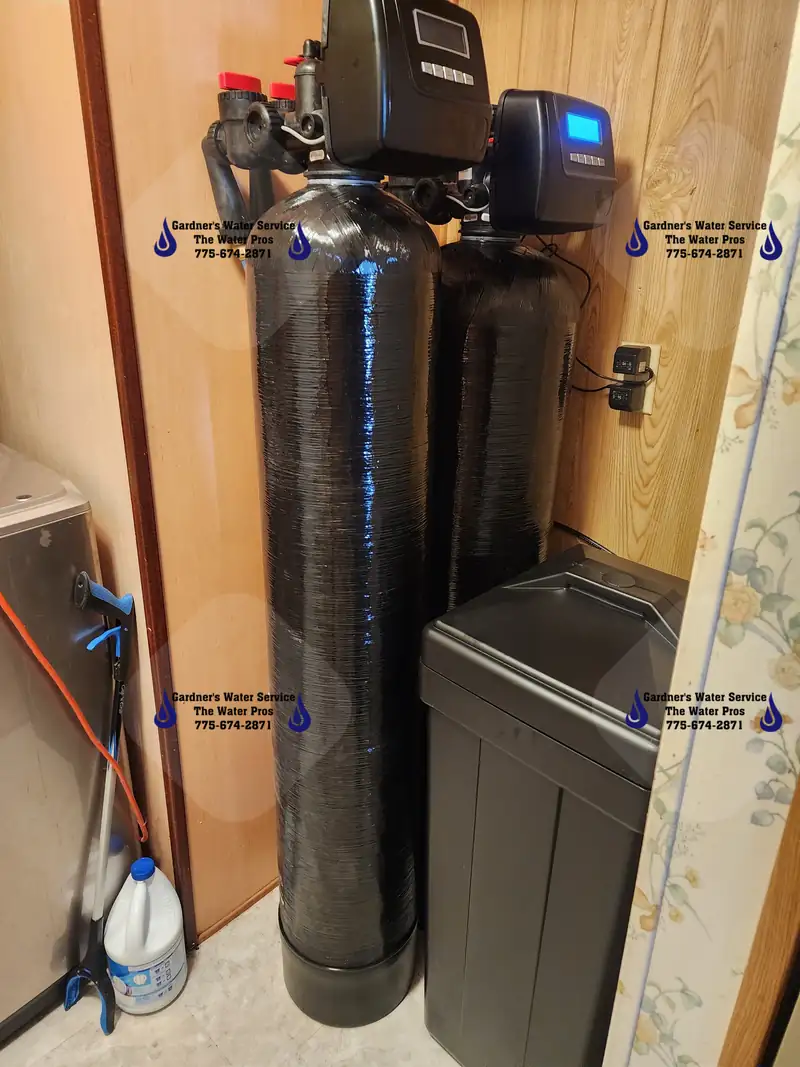
A water softener removes calcium and magnesium from the water by ion exchange, so there is much less mineral to leave behind when the water evaporates. Whether a cooler benefits depends on where its supply line connects: a line taken from the softened plumbing receives treated water, while a line that taps the water supply before the softener does not. We look at how your plumbing is arranged before recommending anything.
On well water, hardness often arrives with iron or other minerals, and those can stain pads and pans in colors of their own. That is another reason to look at the whole picture, not only hardness. Our well water treatment page explains how the pieces fit together.
What does Water Pros do?
We test, then treat. Free local basic testing covers hardness, iron and pH, and you do not have to be an existing customer. If you are on a well, a lab test is typically required to see the health items, and we can point you through it.
When the numbers call for a softener, we install one for homes and businesses. When you already have one, we service it, even if it was not installed by us. Visits use a flat-rate service call fee with no hourly labor charges and no fuel surcharges, and if something we did needs another look we will return at no additional charge. See water softener repair and service or call 775-674-2871.
Sources (2)
- Truckee Meadows Water Authority: TMWA water quality facts / FAQ (checked November 2026)
- U.S. Geological Survey: usgs.gov/special-topics/water-science-school/science/hardness-water (checked November 2026)