
Do I Need a Water Softener?
If your water tests above about 120 mg/L (7 grains per gallon) of hardness, or you see white spots, scale and soap scum, a softener will likely pay off. The way to know for sure is a hardness test, and Water Pros offers free local basic testing to include hardness, iron and pH.
Key points
- The USGS calls water above 120 mg/L hard and above 180 mg/L very hard.
- Hardness in Northern Nevada runs from about 2 grains per gallon in some Reno zones to nearly 30 in parts of Dayton.
- Spots, scale and soap scum are the everyday signs; a test turns the guess into a number.
- Test first, then treat what the test finds.
What does hard water look like at home?
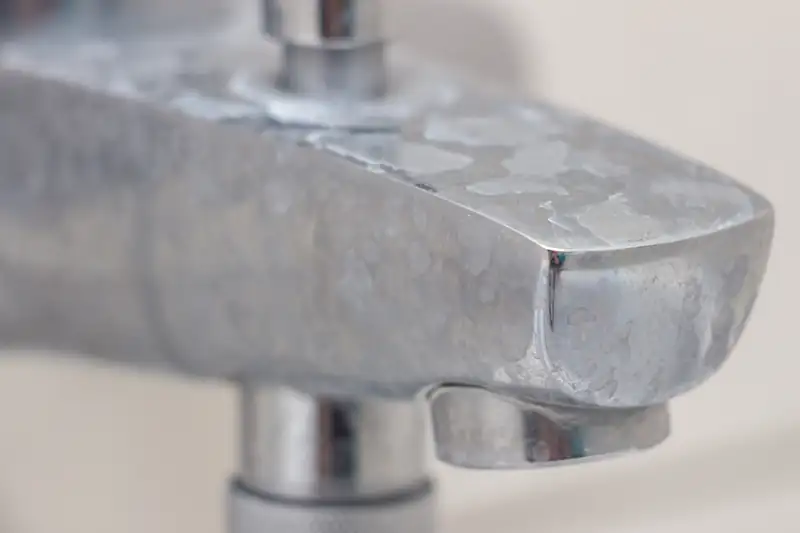
Hard water carries dissolved calcium and magnesium. You see it as white, chalky spots on glasses and shower doors, a crust around faucets, soap that will not lather well, and laundry that feels stiff. Inside the walls, the same minerals leave scale in pipes and on heating elements.
None of that is a health matter. It is a nuisance and a wear-and-tear issue, which is why the decision to add a softener comes down to how hard your water actually is and how much the scale bothers you.
How hard is hard? The numbers
The U.S. Geological Survey rates hardness as calcium carbonate in milligrams per liter: 0 to 60 is soft, 61 to 120 is moderately hard, 121 to 180 is hard, and over 180 is very hard. Many water softener labels use grains per gallon instead. One grain per gallon equals 17.1 mg/L, so the hard line at 121 mg/L is a little over 7 grains.
Here is what Northern Nevada's public water reports show:
| Place | Published hardness | In grains per gallon | Source |
|---|---|---|---|
| Reno and Sparks (TMWA zones) | Zone results from 1.9 to 13.9 gpg, changing from quarter to quarter | 1.9 to 13.9 as TMWA prints it | Truckee Meadows Water Authority water quality lookup |
| Minden | 94 to 140 mg/L | about 5.5 to 8.2, our conversion | Town of Minden Consumer Confidence Report |
| Dayton | 197 to 506 mg/L | 11.59 to 29.76, as the Lyon County report prints it | Lyon County Utilities Consumer Confidence Report |
| Carson City | Described as moderately hard to very hard | varies by source | Carson City Public Works Consumer Confidence Report |
TMWA's neighborhood numbers swing with the seasons because the mix of Truckee River water and well water changes through the year. So the number on the day of your test is a snapshot, and your own tap is the best place to measure it.
Signs a softener is worth considering
A softener is the usual answer when several of these show up together:
- A hardness test above 120 mg/L, or above 7 grains per gallon
- White spots that return a day after you wipe the glass or shower door
- A scaly crust on faucets, showerheads and kettle elements
- Soap scum rings in tubs and sinks, and dingy towels
- A water heater that makes noise or loses efficiency as scale builds up
- A home on a private well, where hardness is not reported by any utility
When a softener is not the first move
Some stains look like hard water but come from something else. Orange or brown staining points to iron, and blue-green marks around copper fittings point to acidic water. A softener can help with small amounts of iron, but larger amounts call for a dedicated iron filter, and acidic water needs pH adjustment.
That is why we test before we recommend. A few minutes with a free basic test tells you whether hardness is the main player or only one of several.
Is the decision different for a home on a well?
Homes on private wells often see harder water than city customers, because groundwater picks up minerals as it moves through rock. No utility publishes a report for your well, so the test at your tap is the only record you will have.
Wells also bring other questions that a softener cannot answer, such as iron, arsenic, nitrate or bacteria. A softener is a good fit for hardness, and a certified lab panel covers the health items. Doing both gives you the whole picture before you spend anything on equipment.
What Water Pros does about it
We start with free local basic testing to include hardness, iron and pH. You do not have to be an existing customer. If your water comes from a private well, we also point you toward a certified lab panel, which is typically required for well water; our guide on how to test well water in Nevada walks through it.
If the numbers call for a water softener, we install and set it up for your household and your water. If you already own one, we service and repair most water treatment equipment, even if it was not installed by us, and our maintenance plans keep it running properly. Homes and businesses on city water or wells are all fair game.
Sources (5)
- U.S. Geological Survey: usgs.gov/special-topics/water-science-school/science/hardness-water (checked November 2026)
- Truckee Meadows Water Authority: TMWA neighborhood water quality lookup, sampling Q4 2025 - Q3 2026 (checked November 2026)
- Town of Minden: Town of Minden CCR covering calendar 2025 (checked November 2026)
- Lyon County: Lyon County Utilities, Dayton Valley water system 2023 CCR (latest posted) (checked November 2026)
- Carson City: Carson City 2026 Water Quality Report (2025 data) - loads in a browser only (403 to scripts) (checked November 2026)