
Buying a Home With a Well or Water System
Before you close on a house with a private well or a water treatment system, order a water test from a Nevada state-certified lab and have the equipment looked over. Water Pros offers free local basic testing for hardness, iron and pH, and we service water treatment systems whether or not we installed them.
Key points
- Nevada's Division of Environmental Protection says a State-certified lab is required for real estate transfer testing.
- The standard lab order is the Routine Domestic Panel, also called an Escrow Package.
- Northern Nevada Public Health handles Washoe County well permits and records, but does not oversee well water quality.
- Water Pros will look over a system we did not install, and you do not have to be an existing customer.
A well, a softener or an iron filter is easy to overlook during a showing, yet it can shape your monthly routine and your first-year budget. The good news is that the questions are simple ones, and you can answer most of them during the inspection period.
What should I test before buying a house with a well?
Ask for a full lab analysis from a Nevada state-certified laboratory, ordered through your agent or escrow officer during the inspection period. The Nevada Division of Environmental Protection (NDEP) states that a State-certified lab is required when the test is for a real estate transfer, and it describes the Routine Domestic Panel, sometimes called an "Escrow Package," as the analysis well owners request for their own information or to satisfy a lender.
A home inspector's report usually covers the pump, the pressure tank and the plumbing. The water itself is a separate question, and a lab panel answers it. In Northern Nevada it is worth asking the lab whether arsenic, uranium and radioactivity are part of the order, since those depend on the local aquifer. Our guide to how to test well water in Nevada walks through the lab list and how to take a good sample.
Who regulates a private well, and who keeps the records?
Nobody tests a private well for you. NDEP's Bureau of Safe Drinking Water does not regulate private well water quality. In Washoe County, Northern Nevada Public Health runs the Domestic Well Program, which handles well permits and records, and its own page says the office does not oversee or regulate domestic well water quality.
That makes the permit file a good place to learn about the well's construction, and the lab report the place to learn about the water. Ask the seller for both, plus any older test results, receipts for filter or salt purchases and the service history of any treatment equipment.
Your pre-closing checklist
Use this list during the inspection window. Items in the first column are things to ask for, and the second column says why each one helps:
| Ask for or check | Why it matters |
|---|---|
| Lab report from a State-certified lab | Shows arsenic, nitrate, uranium, bacteria, TDS and the other items on the panel; required for a real estate transfer |
| Well permit and construction records | Tells you the age of the well and who holds the file at the county |
| Age and make of any softener, iron filter or reverse osmosis unit | Helps plan service and replacement parts |
| Salt, filter or media purchase history | Shows how the owner has been maintaining the system |
| Stains at fixtures, spots on glass, odor | Clues to hardness, iron, manganese or sulfur; a free basic test for hardness, iron and pH confirms them |
| Water heater and fixtures | Scale buildup here often points to hard water |
None of this has to be perfect. The aim is to know what you are buying, so the first month in the house is planning instead of surprises.
What if the house has a softener or other treatment system?
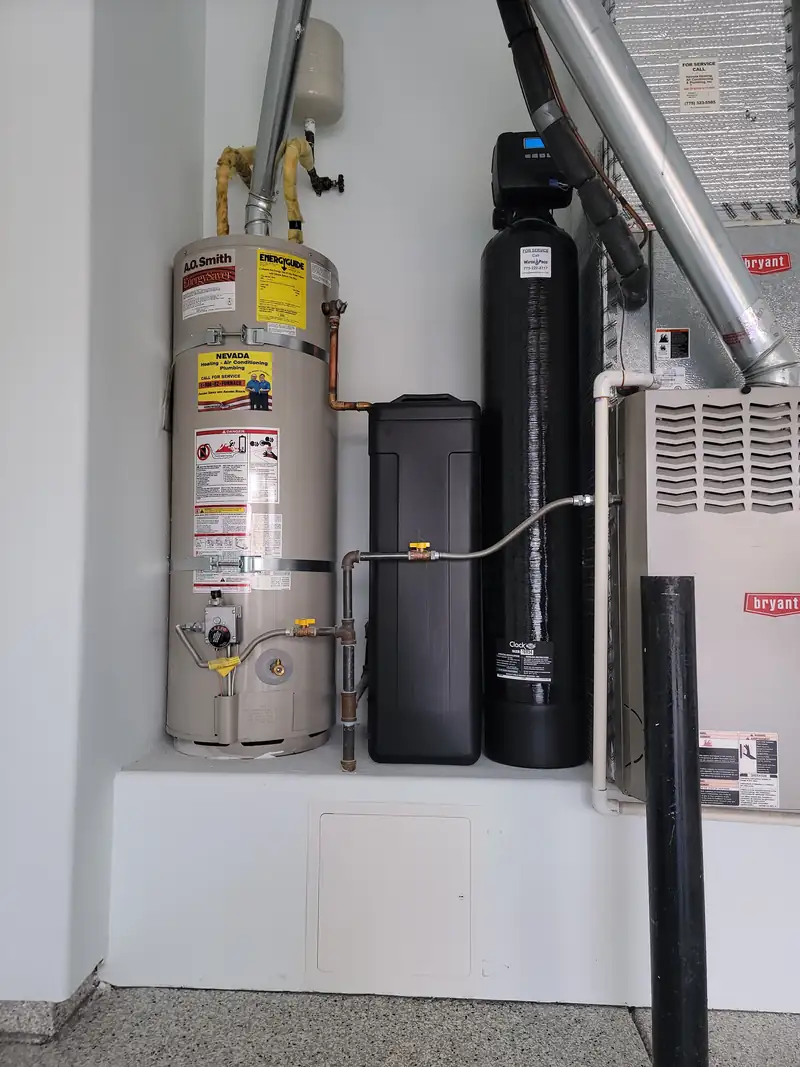
A treatment system is an asset when it has been looked after. Ask the owner how long it has run, when it was last serviced and what it treats. Look at the brine tank, the control head and the plumbing around it, and note any filter housings, such as a whole-house Big Blue, under the stairs or in the garage.
We service most water treatment equipment, even if it was not installed by us. A visit to a new home can include inspection and internal cleaning of a softener or iron filter, a brine tank check, a look at carbon and sediment filters, and a reverse osmosis check with pre-filter and post-filter changes, a TDS test and tank pressure. We call this a new homeowner system check, and our flat-rate service call fee means no hourly labor charges and no fuel surcharges. See our service and repair page for the full list of equipment.
What Water Pros does for a home buyer
Our approach is test, then treat. We start with free local basic testing for hardness, iron and pH, which helps explain the stains and spots you saw at the showing. For well water we recommend lab testing for the health items, since that is typically required and is the only way to know what is in the water.
If the lab report or the basic test points to something, we can talk through the options without any pressure to buy. That might be a water softener for hardness, an iron filter, an arsenic or nitrate system, or a reverse osmosis drinking water system. Our page on well water treatment explains how those fit together. You can reach us at 775-674-2871 or through the scheduling page.
After you move in
Plan a retest once you have settled, because a lab report is a snapshot. We recommend an extensive water analysis for a private well every 3 to 5 years, and UNR Extension suggests a broad panel every 5 to 10 years with yearly checks for nitrate, pH, TDS and coliform bacteria. If a treatment system goes in, retest afterward to confirm it is doing its job, and set up a maintenance plan so filters, media and salt are handled on a schedule.
Sources (5)
- Nevada Division of Environmental Protection: ndep.nv.gov/water/lab-certification/drinking-water-testing (checked November 2026)
- Northern Nevada Public Health: nnph.org/programs-and-services/environmental-health/land-development/well-program.php (checked November 2026)
- Nevada Division of Environmental Protection: ndep.nv.gov/water/drinking-water/information-for-consumers/private-wells (checked November 2026)
- Nevada Division of Environmental Protection: ndep.nv.gov/uploads/water-labcert-dwtesting-docs/WellWaterTesting.pdf (checked November 2026)
- waterprosnv.com: Water Pros: Service & Repair (checked November 2026)